Showing posts with label Lester Bowie. Show all posts

Sunday, October 13, 2013

BYG Actuel 09: Jimmy Lyons - Other Afternoons


It is one of the great misfortunes of BYG Actuel that the label never got the opportunity to record Cecil Taylor. Taylor was present in Paris during the Actuel summer, hanging around the background as the mysterious guru of the scene, but his presence is undocumented as far as records go.

Jimmy Lyons, Alan Silva, and Andrew Cyrille were all crucial components in the BYG Actuel story, but their experiences in Europe did not begin in 1969. These three terrific musicians formed the core of Taylor’s quartet, the Cecil Taylor Unit (which memorably appeared in expanded form on Taylor’s two Blue Note dates, Unit Structures and Conquistador!), had already enjoyed France’s open-arms acceptance of free jazz when the Unit travelled to Paris in 1966.[1] When Taylor returned to Paris three years later, Alan Silva had already moved on to Archie Shepp’s band,[2] but he brought his former Unit bandmates into the fold at the always open Studio Saravah soon after they arrived. All three got their first opportunities to record as leader at Studio Saravah, although none of them could coax Taylor—who didn’t release any albums between 1966 and 1973 and didn’t record any non-live albums again until 1978—into the studio.

Wednesday, September 11, 2013

BYG Actuel 04: Archie Shepp - Yasmina, a Black Woman


Out of the second wave of free jazz musicians,[1] Archie Shepp is part of the trinity of tremendously influential and important saxophonists that shifted the course of the art form, alongside Albert Ayler and Pharoah Sanders. By the time Shepp travelled to Algiers for the Pan-African Festival in 1969, all three were calling Impulse! Records home, but they had sharply diverged in their aims. Ayler was making some ill-advised moves into jazz/R&B fusion; he would be dead of a presumed suicide a year later. Sanders was crafting his own spiritualist identity in the post-Coltrane wilderness and writing some of his best music (including “The Creator Has a Master Plan”) while he was at it.

Unlike these two contemporaries, Shepp was staying the course by transforming his sound. On his second Impulse! album Fire Music, with its odes to the recently assassinated Malcolm X, Shepp had refracted his musical identity directly through the broader civil rights movement. 1965 was the year of X’s death, the Watts riot, and riots and racial violence in urban centers around the country. The Civil Rights Act and the Voting Rights Act did not completely end de jure segregation, but they did shift attention and tension to the de facto segregation that was the hallmark of Northern urban centers. Anger and fire were the orders of the day. By 1969, however, Shepp’s philosophy, and in turn his music, shifted toward cultural nationalism. In 1968 and 1969 he recorded five songs that would make up his final Impulse! release in 1974. That album was named for the Los Angeles based US organization’s new black holiday Kwanzaa.

Sunday, June 23, 2013

BYG Actuel 03: Sunny Murray - Hommage to Africa


There are probably arguments that could be made against this claim, but Sunny Murray is free jazz’s first truly free drummer. Instead of simply keeping time, Murray’s playing is purely expressionistic, pouring his entire being into a cacophony of textural percussion. Considering his place in the free jazz pantheon, it is unsurprising that he cut his teeth in the Cecil Taylor Unit and then in the Albert Ayler Trio and Quartet, three of the most important groups in free jazz’s development. While his playing on albums by these groups, and especially on the Albert Ayler Trio’s fiery Ghosts, is rightfully lauded by fans and critics, his work as a bandleader is too often overlooked. He recorded two great ESP-Disks—1965’s Sunny’s Time Now and 1966’s Sunny Murray—while still a member of Ayler’s band—along with the transitional Big Chief for EMI/Pathe in 1968 between his stint with Ayler and Archie Shepp’s invitation to join him at the Panafrican Festival at the start of the next summer. While Murray’s first three albums as leader are very good, Murray’s voice is still very much tied to his work with Ayler. Murray’s time with Shepp and his experiences recording for BYG Actuel freed him of these stylistic constraints and allowed him to find his own voice as a writer.

Tuesday, June 4, 2013

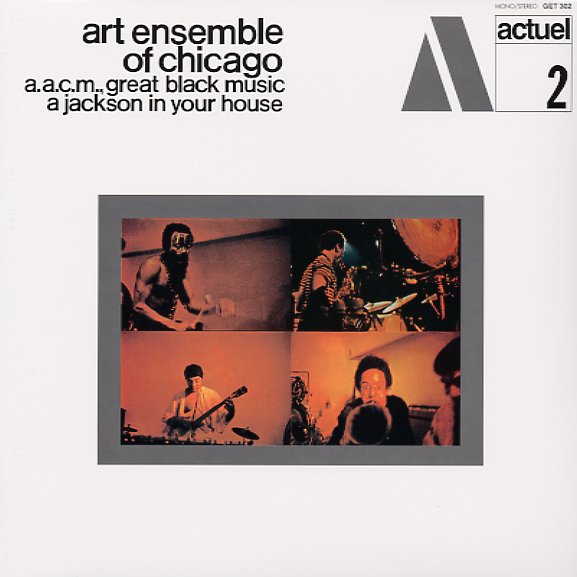
BYG Actuel 02: Art Ensemble of Chicago - A Jackson in Your House


Even though I think all of the group’s members are incredible players and a few of their group albums are free jazz masterpieces, I still really struggle with much of the Art Ensemble of Chicago’s music. A good portion of their most early work as a group sounds to me like collections of interesting elements thrown together in a haphazard way. They eventually honed in on what they were trying to do and became fairly consistent at tapping into that, but their early stuff, including their debut album A Jackson in Your House from 1969, is more noteworthy as a look into the group’s evolution than as a standalone recording.

Prior to A Jackson in Your House, the members of the AEC had collaborated on several albums by the group’s individual members starting with the Roscoe Mitchell Sextet’s brilliantly iconoclastic Sound in 1966. While these albums are great, they each clearly have one leader steering the group’s music, whether it be Mitchell (on Sound and Congliptious) or Lester Bowie (on Numbers 1&2). Their first recorded forays under the AEC name and their BYG albums especially show their first attempts to perform truly leaderless music. It took a few years to really work out the kinks in this democratic approach to their art.