Showing posts with label BYG Actuel. Show all posts

Saturday, January 25, 2014

BYG Actuel 14: Acting Trio - Acting Trio

The European free improvisation scene has produced a handful of genuine iconoclasts. While that term tends to get thrown around a lot, especially when talking about free jazz and free improvisation, the greatest of the European free improvisers truly reoriented music permanently. They managed to break free from the bonds of the jazz tradition that ran through the music of their American contemporaries and create something wholly European. Peter Brötzmann, Han Bennink, and Alexander von Schlippenbach from Germany and Evan Parker and Derek Bailey from the UK stand as possibly the most recognized of the titanic iconoclasts of European improvisation. These five are not only representative of the scene as a whole in terms of their musical advancements but in their countries of origin. Germany and Britain have served as the binary stars around which European improvisation has orbited for the last 45 years.

Yet this does a disservice to the other countries that have produced great, innovative players who haven’t reached the level of recognition as their German and British peers. While BYG Actuel primarily released records by expatriate American musicians, it wasn’t totally blind to the advancements occurring in its own country. Michel Puig, Jacques Coursil, and the ever-present Claude Delcloo all led albums for the label, but these artists (with the exception of Coursil) are eclipsed by the mysterious Acting Trio, whose self-titled album was the fourteenth that Actuel put out.

Sunday, November 3, 2013

BYG Actuel 13: Paul Bley - Ramblin'

There have already been a few anomalies in the BYG Actuel catalog so far: the avant classical of Michel Puig, the psychedelic proto-prog of Gong, and the never-issued blues rock of Alan Jack Civilization. Number 13 in the Actuel catalog is also an anomaly, although not primarily on stylistic grounds. Unlike almost all of the fifty-three albums in the label’s catalog, Paul Bley’s Ramblin’ was not recorded in the Actuel summer in 1969. It wasn’t even recorded in France. Instead, it was an unused recording that Paul Bley’s trio made in Rome in 1966 that Bley licensed to Actuel three years later. As such, it is missing that particular adventurous spirit that marks so much of the rest of that catalog.

By the time he recorded Ramblin’, Bley had already been an important figure in boundary-pushing jazz for thirteen years. His debut album as leader, Introducing Paul Bley, was released on Debut in 1953, and he somehow managed to wrangle Charles Mingus and Art Blakey to be his sidemen. He was one of the first respected jazz musicians to really get behind what Ornette Coleman and his band were doing, and he brought Coleman, Don Cherry, Billy Higgins, and Charlie Haden to perform with him in California in 1958. After his work with Coleman, he got around quite a bit, performing with Jimmy Giuffre, Sonny Rollins, and a few prominent members of the Sun Ra Arkestra, among others. By 1964, he was firmly entrenched in the free jazz movement and he was one of the major participants in the October Revolution in Jazz. After the October Revolution he, his wife Carla Bley, and Bill Dixon spearheaded the Jazz Composers Guild, an admirable but flawed attempt to unify out jazz musicians in order to help them get stage time and fair record contracts. Infighting and the individual success of some members (most notably Archie Shepp, who violated Guild bylaws by signing with Impulse! without consulting the others) caused the JCG to splinter quickly. After the JCG ceased to be, Bley traveled to Europe with his trio, which at the time included Mark Levinson on bass and Barry Altschul on drums. While in Rome on July 1, 1966, the group convened at Studio RCA to record one Paul Bley song along with five compositions by Carla Bley, Annette Peacock, and Ornette Coleman.

Saturday, November 2, 2013

BYG Actuel 12: Alan Silva and His Celestrial Communication Orchestra - Luna Surface


I haven’t gotten a chance to see Gravity yet but from what I’ve heard, the experience of seeing it on an Imax screen in 3D can induce existential terror at the vast emptiness of space and our fragility in the face of the forces of the cosmos. Forty-four years earlier, Alan Silva and His Celestrial Communication Orchestra[1] accomplished that same thing musically with their first album for BYG Actuel, Luna Surface. Recorded less than a month after the Apollo 11 spacecraft touched down on the lunar surface, the album is both an incredibly assured debut as leader for Silva and a chaotic, relentless journey into the horrors of outer space.

Alan Silva was born in Bermuda in 1939 but he migrated with his mother to Harlem before the end of World War II. He picked up the bass at some point in this childhood and he made his first major splash on the instrument as a participant in the landmark October Revolution in Jazz, which trumpeter Bill Dixon put on at the Cellar Door in Manhattan. Around the same time he spent a brief time in Sun Ra’s Arkestra, giving him a taste for larger ensembles that he kept in the back of his mind over the next five years, which he spent in smaller bands led by Cecil Taylor, Albert Ayler, Sunny Murray, and Archie Shepp. It was with the latter that Silva travelled to Algiers in July 1969 to perform at the Pan-African Festival which put him at ground zero for the nascent Actuel summer.

Sunday, October 27, 2013

BYG Actuel 11: Archie Shepp - Poem for Malcolm


Archie Shepp’s remarkable first full studio album Four for Trane[1] consists mostly of Coltrane covers—unsurprising considering the title—but his follow-up Fire Music, recorded in the wake the assassination of Malcolm X, counts three Shepp compositions alongside tunes by Duke Ellington and Antonio Carlos Jobim. The last of these Shepp compositions is “Malcolm Malcolm Semper Malcolm,” a brief poem reflecting on X’s passing, which happened a week before the recording, followed by an expressive, pained solo by Shepp with minimal backing by David Izenzon and J.C. Moses on bass and drums respectively.

Malcolm X is not an explicit presence on any of Shepp’s albums in the four years after Fire Music, although his legacy haunts every sonic, cultural, and personal exploration that Shepp undertook during this time. In August 1969, when Shepp recorded three studio albums for BYG Actuel over the course of five days, he decided to grapple once again with the X’s towering legacy. What’s more, he again chose to use a poem to do this on “Poem for Malcolm,” which closes out the first side of the album of the same name.[2]

Monday, October 14, 2013

BYG Actuel 10: Alan Jack Civilization - Bluesy Mind


The tenth album in the BYG Actuel catalog was never issued on that label. Instead, it was transferred over to a much more suitable home over on BYG proper, where it was ultimately released in 1970. Listening to Bluesy Mind, it makes perfect sense why it didn’t find a home on BYG Actuel. For a label whose hallmark was relentless experimentation, with artists pushing past the established boundaries of their music and intrepidly exploring what lay beyond, it’s amazing that those in charge would ever consider releasing an album of generic blues rock long enough for it to be assigned a catalog number before being pulled at the last minute.

Nothing about Alan Jack Civilization’s Bluesy Mind is bad. It is a very competent record. But that’s precisely the problem. The label’s first outright failure, Michel Puig’s Stigmates (Actuel 07), is at least a document of an artist that went out on a limb and tried something new. Puig’s failure is a noble and memorable one. By being merely competent, the Alan Jack Civilization managed to create an album that isn’t any more memorable on its tenth listen than it is on its first. None of the nine songs, with the exception of the sprawling “Middle Earth,” which is just barely interesting, stick in any way. Any blues rock fan would be much better off reaching for their copies of Projections, East-West, Blues Breakers with Eric Clapton, or Super Session, to say nothing of albums by superstars like the Rolling Stones, Cream, the Yardbirds, and the Animals.

Sunday, October 13, 2013

BYG Actuel 09: Jimmy Lyons - Other Afternoons


It is one of the great misfortunes of BYG Actuel that the label never got the opportunity to record Cecil Taylor. Taylor was present in Paris during the Actuel summer, hanging around the background as the mysterious guru of the scene, but his presence is undocumented as far as records go.

Jimmy Lyons, Alan Silva, and Andrew Cyrille were all crucial components in the BYG Actuel story, but their experiences in Europe did not begin in 1969. These three terrific musicians formed the core of Taylor’s quartet, the Cecil Taylor Unit (which memorably appeared in expanded form on Taylor’s two Blue Note dates, Unit Structures and Conquistador!), had already enjoyed France’s open-arms acceptance of free jazz when the Unit travelled to Paris in 1966.[1] When Taylor returned to Paris three years later, Alan Silva had already moved on to Archie Shepp’s band,[2] but he brought his former Unit bandmates into the fold at the always open Studio Saravah soon after they arrived. All three got their first opportunities to record as leader at Studio Saravah, although none of them could coax Taylor—who didn’t release any albums between 1966 and 1973 and didn’t record any non-live albums again until 1978—into the studio.

Monday, October 7, 2013

BYG Actuel 08: Burton Greene Ensemble - Aquariana


Ornette and Trane are the two most towering figures in free jazz, and as such the wildly expressive saxophone has remained the most dominant instrument in the genre for the last fifty years. So while pianist Cecil Taylor is undoubtedly the third member of this trinity of free jazz progenitors, the saxophone has muscled the piano out of the forefront of free jazz.[1] There have been many free piano greats, from Muhal Richard Abrams in Chicago to Alexander von Schlippenbach in Berlin, and on up to recent titans like Matthew Shipp, but their number is dwarfed by those of saxophonists.

BYG Actuel was able to even the playing field a bit by allowing so many musicians the opportunity to record their own albums as leader. So while there are many saxophonists who recorded for the label, Actuel also released records by the pianists Paul Bley, Dave Burrell, Joachim Kuhn, the incomparable Sun Ra, and Burton Greene, who was the first of his comrades to get an album out on the label. Aquariana is not quite the best piano album that the label put out,[2] but it is an excellent showcase for a unique musician and composer.

Sunday, September 29, 2013

BYG Actuel 07: Michel Puig - Stigmates


And now for BYG Actuel’s first serious misstep. Stigmates is not the label’s last foray into contemporary (for the time) classical,[1] but it is certainly its worst. It’s telling that nothing from this record was included on the Jazzactuel compilation and that he’s been basically wiped from the popular (if you can call anything this niche popular) memory of the label.

Saturday, September 28, 2013

BYG Actuel 06: Claude Delcloo & Arthur Jones - Africanasia


The trajectory of alto saxophonist Arthur Jones’ career is one of the more disappointing stories in free jazz. The sounds of Ornette and Trane attracted him from his birthplace of Cleveland to New York City, and he made his recorded debut in 1967 on tenor saxophonist Frank Wright’s ESP-Disk Your Prayer. The next year, he traveled to Paris as part of Jacques Coursil’s band and became an integral if underappreciated part of the community of musicians hovering around Studio Saravah.[1] He played on seven Actuel records by Coursil, Sunny Murray, Archie Shepp, Dave Burrell, Clifford Thornton, and Burton Greene, and he recorded two albums, Africanasia and Scorpio, as leader or co-leader. After 1970, when Scorpio was released (it was one of the last records that the label released), Jones disappeared from recorded jazz, save for an appearance on Archie Shepp’s live Bijou album, recorded in Paris in 1975. His name basically disappears from the historical record after that, and he died in 1998 in the midst of a return to performing after a long hiatus.

Had things gone differently, Arthur Jones could have been one of the major figures in the loft scene in New York during the seventies. He was a wonderfully expressive player, infusing a bebop sensibility into his expansive solos. Even if he never recorded again as leader, he would have been a valuable member of any ensemble in both live and recorded settings. As he makes clear repeatedly on Africanasia, he was more than willing to step out of the way of his fellow musicians when it benefitted a composition, but he was consistently capable of being the defining voice during any passage in which he played.

Wednesday, September 25, 2013

BYG Actuel 05: Gong - Magick Brother

There is a moment halfway through “Mystic Sister/Magick Brother,” the opening track on Gong’s 1969 debut album Magick Brother, in which the band members all seem to forget what they’re doing all at once and drift out of the mix. They take a few seconds to reorganize and remember what they were supposed to be doing, and they all start up again. The moment is both charming and frustrating. Even mid-song, the band wasn’t quite sure what they were going for. At this stage in their career, Gong was a soon-to-be great band stumbling toward a breakthrough and knocking over a lot of stuff on the way. For a fledgling free jazz label like BYG/Actuel, it’s an unfortunate first excursion beyond its established jazz framework.

Wednesday, September 11, 2013

BYG Actuel 04: Archie Shepp - Yasmina, a Black Woman


Out of the second wave of free jazz musicians,[1] Archie Shepp is part of the trinity of tremendously influential and important saxophonists that shifted the course of the art form, alongside Albert Ayler and Pharoah Sanders. By the time Shepp travelled to Algiers for the Pan-African Festival in 1969, all three were calling Impulse! Records home, but they had sharply diverged in their aims. Ayler was making some ill-advised moves into jazz/R&B fusion; he would be dead of a presumed suicide a year later. Sanders was crafting his own spiritualist identity in the post-Coltrane wilderness and writing some of his best music (including “The Creator Has a Master Plan”) while he was at it.

Unlike these two contemporaries, Shepp was staying the course by transforming his sound. On his second Impulse! album Fire Music, with its odes to the recently assassinated Malcolm X, Shepp had refracted his musical identity directly through the broader civil rights movement. 1965 was the year of X’s death, the Watts riot, and riots and racial violence in urban centers around the country. The Civil Rights Act and the Voting Rights Act did not completely end de jure segregation, but they did shift attention and tension to the de facto segregation that was the hallmark of Northern urban centers. Anger and fire were the orders of the day. By 1969, however, Shepp’s philosophy, and in turn his music, shifted toward cultural nationalism. In 1968 and 1969 he recorded five songs that would make up his final Impulse! release in 1974. That album was named for the Los Angeles based US organization’s new black holiday Kwanzaa.

Sunday, June 23, 2013

BYG Actuel 03: Sunny Murray - Hommage to Africa


There are probably arguments that could be made against this claim, but Sunny Murray is free jazz’s first truly free drummer. Instead of simply keeping time, Murray’s playing is purely expressionistic, pouring his entire being into a cacophony of textural percussion. Considering his place in the free jazz pantheon, it is unsurprising that he cut his teeth in the Cecil Taylor Unit and then in the Albert Ayler Trio and Quartet, three of the most important groups in free jazz’s development. While his playing on albums by these groups, and especially on the Albert Ayler Trio’s fiery Ghosts, is rightfully lauded by fans and critics, his work as a bandleader is too often overlooked. He recorded two great ESP-Disks—1965’s Sunny’s Time Now and 1966’s Sunny Murray—while still a member of Ayler’s band—along with the transitional Big Chief for EMI/Pathe in 1968 between his stint with Ayler and Archie Shepp’s invitation to join him at the Panafrican Festival at the start of the next summer. While Murray’s first three albums as leader are very good, Murray’s voice is still very much tied to his work with Ayler. Murray’s time with Shepp and his experiences recording for BYG Actuel freed him of these stylistic constraints and allowed him to find his own voice as a writer.

Tuesday, June 4, 2013

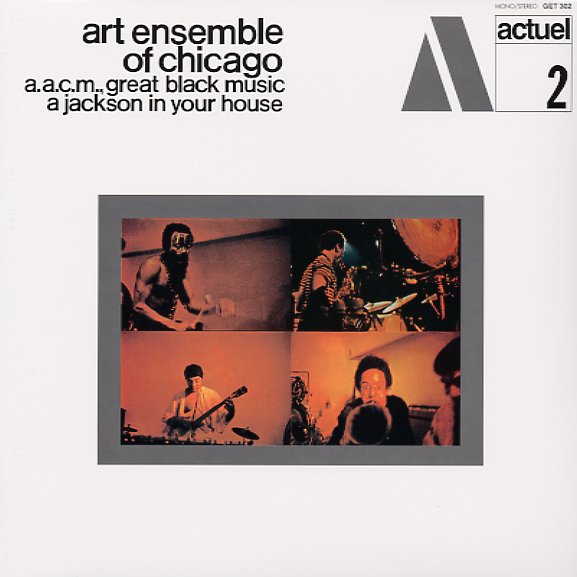
BYG Actuel 02: Art Ensemble of Chicago - A Jackson in Your House


Even though I think all of the group’s members are incredible players and a few of their group albums are free jazz masterpieces, I still really struggle with much of the Art Ensemble of Chicago’s music. A good portion of their most early work as a group sounds to me like collections of interesting elements thrown together in a haphazard way. They eventually honed in on what they were trying to do and became fairly consistent at tapping into that, but their early stuff, including their debut album A Jackson in Your House from 1969, is more noteworthy as a look into the group’s evolution than as a standalone recording.

Prior to A Jackson in Your House, the members of the AEC had collaborated on several albums by the group’s individual members starting with the Roscoe Mitchell Sextet’s brilliantly iconoclastic Sound in 1966. While these albums are great, they each clearly have one leader steering the group’s music, whether it be Mitchell (on Sound and Congliptious) or Lester Bowie (on Numbers 1&2). Their first recorded forays under the AEC name and their BYG albums especially show their first attempts to perform truly leaderless music. It took a few years to really work out the kinks in this democratic approach to their art.

Tuesday, April 30, 2013

BYG Actuel 01: Don Cherry - "Mu" First Part


If the Festival Actuel is any indication, the founders of BYG intended their Actuel imprint and their brand as a whole to represent forward-thinking global music in any genre, with free jazz being the particular focus. Had financial mismanagement and the insane overreaching that came with holding such a gigantic festival so soon after the label’s founding not tanked BYG, it is not unreasonable to believe that BYG Actuel could have become one of the avant-grade musical leaders on the European continent. With these lofty ambitions, the first Actuel release had to set the tone and the standard of quality for the albums ahead and draw attention to the brand new subsidiary label. A minor public relations coup resulting from signing an established artist was certainly a helpful bonus as well. The label got all of this with “Mu” First Part, the first of two duo albums by Ornette Coleman Quartet alums Don Cherry and Ed Blackwell.

Saturday, April 13, 2013

BYG Actuel 00: Jazzactuel Intro

ESP-Disk is the best and most important free jazz label of all time. While larger labels like Atlantic, Blue Note and Impulse! dabbled in the fresh musical territory that was free jazz in the mid-sixties, ESP-Disk was the first record company to really devote itself to this music.[1] Albert Ayler, Marion Brown, Pharoah Sanders, Sun Ra, Patty Waters, Milford Graves, Paul Bley, Ornette Coleman, Henry Grimes, Frank Wright, Gato Barbieri, and the New York Art Quartet all put out some of their defining material on the label. Artists maintained complete artistic control of their ESP discs, making it one of the best outlets for avant-garde musicians in spite of the label’s spotty history of actually paying its artists.

Other great labels followed ESP-Disk’s example in the late sixties and into the seventies. India Navigation, Flying Dutchman, Delmark, and Black Saint cropped up in the states to handle the rapidly multiplying number of free players in a musical environment that was openly hostile toward free jazz. In Europe musicians started their own labels, including FMP and Incus, to release their radical explorations of free improvisation’s outer edges.