Saturday, February 16, 2013

Spray Cans Vol. 004: 1st Down - "A Day Wit the Homiez" b/w "Front Street"

1st Down - "A Day Wit the Homiez" b/w "Front Street" (Payday Records, 1995)
 
This month is the seventh annual Dilla month, in which fans of the late J Dilla celebrate his contributions to hip hop in remembrance of his premature death at the age of 33 on February 10, 2006. This month has seen the release of Music from the Lost Scrolls Vol. 1, an EP of four unreleased tracks, and the announcement of The Diary, an unreleased album showcasing Dilla’s (still mostly underappreciated) skills as a rapper. The purpose of this feature is to look back at overlooked 12” singles from the past, so along with being excited that his estate seems to be in much better hands than it was previously (the debacle surrounding The Rebirth of Detroit best illustrates the problems that Dilla’s posthumous catalog has had), we should look back to the pre-Dilla days, before his work with De La Soul, A Tribe Called Quest, and the Pharcyde, when James Yancey was known as Jay Dee.

After producing one song on Da’ Enna C’s Throw Ya Hands in the Air 12” in 1994, Jay Dee made his first real mark the next year with the first and only single released by his original pre-Slum Village group 1st Down. While Jay Dee made his rap debut with Slum Village when their Fan-Tas-Tic (Vol. 1) bootleg began circulating among in the know hip hop heads in 1997, he served strictly as producer in 1st Down, with underrated Detroit emcee Phat Kat holding down the mic. 1st Down’s early songs were so promising that Payday Records, home of Showbiz & A.G., Jeru the Damaja, and other New York legends, signed them and they became the first Detroit artists on the label. 


Lyrically, the two songs on the 1st Down 12” complement each other quite nicely. The A-Side, “A Day Wit the Homiez,” has Phat Kat doing an “It Was a Good Day”-type thing (but without the lingering threat of violence that hangs around the background of the Ice Cube hit), rapping about how much fun he has chilling with his homies, going to the club, and driving around. Phat Kat has never really gotten the credit he deserves as a storyteller, filling “A Day Wit the Homiez” with lots of evocative little details, like saving up change to help other people get into the club. By contrast, the B-Side “Front Street” calls out all of the wack rappers fronting like they’re Dr. Dre and Snoop Doggy Dogg when they’re really just studio gangstas. The subject matter on “Front Street” is nothing new, but Phat Kat’s energy level and entertaining lyrics push it outside the realm of cliché.

Phat Kat is good rapper, but it’s unlikely that the songs would have much staying power without Jay Dee’s production. In the year following the 1st Down 12”, Jay Dee recorded “Stakes is High” with De La Soul, worked on seven of the songs on the Pharcyde’s sophomore album Labcabincalifornia (including the immortal “Runnin’” and “Drop”), formed the Ummah with Q-Tip and Ali Shaheed Muhammad and began work on the fourth A Tribe Called Quest Record, and recorded the demos that made up Slum Village’s Fan-Tas-Tic (Vol. 1). Jay Dee’s 1996 is one of the most impressive runs of any producer in the history of hip hop, and the songs on 1st Down’s lone single are valuable for showing the early Jay Dee style exhibited on his 1996 work in its embryonic stage. The drunk-sounding unquantized drums, the sparse sample chops, and the subtle bass work are all present, but Jay Dee hadn’t quite perfected his own style yet. On “Front Street,” he even put sleigh bells in his beat, following a trend set by Buckwild and other New York producers. The Jay Dee of just one year later wouldn’t have dreamed of following the sonic trends of others.

Payday Records folded right after the 1st Down record came out, and the group split up, allowing Jay Dee to focus on his work with the Ummah and Slum Village, while Phat Kat began building his solo career. “It Don’t Get No Liver Than This” and “No Place to Go,” two unreleased songs that the duo recorded for Payday, were included on a 2002 CD reissue of the single, along with an underwhelming remix of “Front Street,” and the duo continued to work together until Jay Dee’s death in 2006. Phat Kat showed up as a featured artist on standout tracks from Fan-Tas-Tic (Vol. 1) and Jay Dee’s solo debut album Welcome 2 Detroit, and Dilla produced multiple songs on Phat Kat’s albums The Undeniable LP (2004) and Carte Blanche (2007). Taken together, this decade-plus of collaborations makes for a pretty top notch 1st Down catalog, and it’s a shame that Dilla’s premature death prevented another proper 1st Down project.

"A Day Wit the Homiez"

"Front Street"

Friday, February 15, 2013

"Viola Lee Blues" and the Grateful Dead's Relationship with Chaos


There is a segment of my family for whom the Grateful Dead is nearly a religion. Being a Deadhead is one of the main pillars on which their musical identities rest. In spite of the frequent exposure to the band that their devotion has caused as well as several attempts to immerse myself in their catalog (studio and live albums as well as bootleg show tapes), I’ve always struggled with the Dead. This is due I think primarily to two reasons.[1] The sheer amount of their output is the first and primary reason. I’ve heard all of their studio albums from their debut through to 1977’s Terrapin Station, and only four (their self-titled debut, American Beauty, From the Mars Hotel and Blues for Allah) have really made much of an impression, and even still, I rarely listen to them. The Dead were always at their best live (well not always, I’m sure they had their off nights), and I’ve enjoyed both Live/Dead and Europe ’72, though not enough to return to them frequently. At the center of the cult of the Dead is the thousands of bootleg live tapes have been completely overwhelming due to their sheer quantity. My understanding is that the changes in their live show over the years were so distinct that the most dedicated of Deadheads will know within the first song what year or tour a particular tape is from, but I haven’t immersed myself enough to even know which years of their career would be most in line with my tastes.

This brings me to my second major hurdle with the Dead: their style of songwriting and jamming is not one that appeals to me that much. If I’m going to listen to live jams from the Dead’s first decade or so of activity (1965-1977), I much prefer the heroin-indebted noise of the Velvet Underground’s 1969: The Velvet Underground Live or the space rock drones of Hawkwind’s Space Ritual. Outside of this twelve year period, I turn to the psychedelic chaos of Acid Mothers Temple and the drone metal of Boris, among others, or eschew rock altogether in favor of exploratory or abrasive free jazz. By contrast, the Grateful Dead’s music is rooted primarily in bluegrass, country, folk, and other sounds that don’t grab me as immediately as the aforementioned styles do. Moreover, even with all of the noodling and endless jams and ridiculous amounts of drugs, pretty much everything I’ve heard from them sounds like the band is completely in control of their music. I can really only think of one time in the hours of Grateful Dead music I’ve heard where they sound like they give in to chaos: “Viola Lee Blues,” the final track from their self-titled debut album.

“Viola Lee Blues,” a cover of a Noah Lewis standard, is nearly twice as long as any other song on The Grateful Dead, and has a much liver feel than anything else on this record or any other studio album they put out in the sixties. During the song’s first third it is a fairly standard, if slightly heavier than normal, early period Dead song, with Jerry Garcia’s singing through much of it. A little more than a third of the way in, however, Jerry steps away from the microphone and the band gets into a really excellent jam. After a few minutes, at about the eight minute mark, it starts to sound like the acid that they were probably on was taking a bad turn, and the tight jamming begins coming apart at the seams. Jerry’s guitar line starts tripping over itself and then descends into feedback, and Pigpen’s keyboard follows suit, burying the drums, bass, and rhythm guitar in noise. And then suddenly, with 70 seconds to go, the Grateful Dead ship abruptly rights itself and the band returns to the original song, vocals and all. It’s an exhilarating mess, abandoning logical transitions in favor of letting chaos take over for a while.

Does “Viola Lee Blues” point toward a potential missed opportunity for the band? Could they have explored noise and chaos a bit more than they ultimately did? I haven’t heard any live tapes from this era so I have no idea if they’re more noisy and chaotic than the tapes from 5-10 years later that I’m more familiar with. My difficulty with the rest of their catalog and my lack of knowledge of where to start tapes-wise has deterred me from pursuing this era of Grateful Dead concerts, but returning to “Viola Lee Blues” over the last few days has reignited my interest. If my favorite minute from any Grateful Dead studio album is not reflective of anything the band was pursuing live around this time, then I’ll be sorely disappointed. Ten years later, the band released Terrapin Station, a studio album with a mix that buffs off all of the rough edges the band might have had left in their music. It’s my least favorite studio record I’ve ever heard of theirs (although admittedly I’ve never ventured into the wasteland that I’ve heard their eighties records supposedly are). I think the mix on Terrapin Station is indicative of the direction the band’s music ultimately took, and that direction is why they’ve never appealed to me as much as some of their contemporaries have. An alternate trajectory for the band could have had them pursuing this noisier direction in some of their music without fully abandoning their primary jammy folk/bluegrass sound. Had they really embraced the darkness and the unknown that is so much a part of death and really lived up to the second half of their name, I’d probably be a Deadhead.


[1] Well three, actually, with the third reason being that I’ve never been crazy about Jerry Garcia or any other member of the band’s vocals. When it comes to their live shows, however, the instrumental portions generally outweigh the vocal portions in both length and importance, so I try not to let my indifference to their singing get too much in the way of the listening experience.

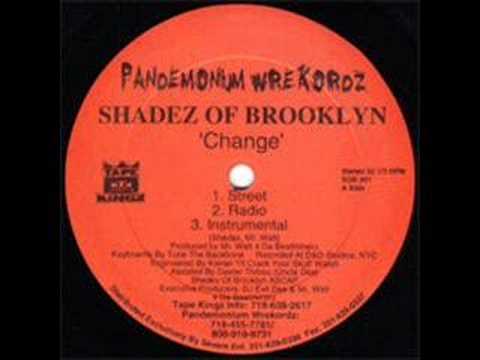
Spray Cans Vol. 003: Shadez of Brooklyn - "Change" b/w "When it Rains it Pours (Survival Warz!)"

Shadez of Brooklyn - "Change" b/w "When it Rains it Pours (Survival Warz!)" (Pandemonium Wrekords, 1996)
There’s a type of rap song that became briefly very common in New York in the mid-90s: a sort of autobiographical, “here’s how hip hop saved me from a life of crime and poverty” story song. The most famous two examples of this type of song are Wu-Tang Clan’s “C.R.E.A.M.” and “Juicy,” the breakthrough single from the Notorious B.I.G.’s debut album Ready to Die. Both songs were released as singles in 1994, and both did more to solidify their initial widespread fanbase than anything they had done previously. “C.R.E.A.M.” and “Juicy” also represent opposite ends of the spectrum when it comes to these type of songs, with the former sounding like the work of artists who haven’t fully removed themselves from the life that their rap career is allowing them to escape[1], and the latter showing Biggie reveling in a life of luxury while looking back on how hip hop helped him through his impoverished childhood and his days as a drug dealer. 

For their debut single in 1996, it makes sense that Shadez of Brooklyn would try to mine similar territory as these artists, who by that year were among the most popular and acclaimed in hip hop. Not only did they cover similar subject matter, but the quartet managed to transcend their own ability and record a song, “Change,” that is not only their best song by a wide margin, but also one of the best songs on this subject in hip hop history.[2] The main reason for this song’s success is a direct result of the group’s affiliation with Da Beatminerz (originally DJ Evil Dee and Mr. Walt), who rank among the best producers in hip hop history who don’t get anywhere near the attention they deserve.[3]

Shadez originally hooked up with Da Beatminerz through Chocolate Tye, who was childhood friends with Mr. Walt and hung around the legendary D&D Studios in New York while Da Beatminerz were working on the early Boot Camp Clik records. He became a part of the expanded Beatminerz lineup (along with Baby Paul and Rich Blak) around the same time he formed Shadez of Brooklyn with fellow rappers Tee Black, Rambo, and Rev. Al. Chocolate Tye’s presence in both groups got Shadez a deal with Pandemonium Wrekords, the label run by Evil Dee and Mr. Walt, as well as studio time at D&D, where they recorded three Beatminerz-produced singles between ’96 and ’98. 

  
The first of these singles, “Change” b/w “When it Rains it Pours (Survival Warz!)” illustrates everything that was going right and everything that was going wrong with both groups at this time. “Change” features a beat by Mr. Walt that uses a gorgeous sample of Ahmad Jamal’s piano playing on the title track of his 1970 Impulse! Records album The Awakening.[4] This sample gives the song a vintage feel befitting the remembrances that dominate the lyrical content. The choice of subject gives the four good but not great emcees a level of focus that isn’t present on anything else the group released in their brief career. Their stories, which range from one member’s birth through the perils of ghetto life and onto the formation of Shadez of Brooklyn, give “Change” as personality that their other songs lack. Unlike Biggie’s “Juicy,” these guys don’t have a luxurious new lifestyle to boast about, they just have an optimism and a confidence in their ability to rise to the top of the rap world as their predecessors did. This place “Change” squarely in the center of the “C.R.E.A.M.”/”Juicy” spectrum.

By contrast, the b-side, “When it Rains it Pours (Survival Warz!)” clearly shows the group’s shortcomings. With the possible exception of Baby Paul, none of the three late addition Beatminerz had the skill level of the two founders, and their presence ultimately watered down the Beatminerz sound. Rich Blak’s beat on this song is characteristically marked by average drums and an underwhelming sample loop. Without a beat on the level of “Change” it becomes quickly evident that the four rappers in Shadez of Brooklyn are capable but generally unimpressive rappers, and their moderate skill level prevents the song from distinguishing itself among the hundreds of songs with its exact subject matter released around the same time. Ultimately, while “Change” lodges itself in your brain, “When it Rains it Pours (Survival Warz!)” is barely memorable.

Shadez of Brooklyn disintegrated by the end of the 90s, and Chocolate Tye moved to Houston, where he remained a satellite member of Da Beatminerz until Evil Dee and Mr. Walt jettisoned the other members after releasing the Brace 4 Impak album in 2001. Da Beatminerz’s recorded legacy over the last decade has been checkered at best, as Evil Dee and Mr. Walt both fell off, only occasionally matching their mid-90s glories. Since they never released a full album to sit alongside the early Boot Camp Clik catalog, Shadez of Brooklyn were almost completely forgotten in the fifteen years after their dissolution. For “Change” alone, the group’s legacy deserves to be maintained, and the song endures as one of the finest songs Da Beatminerz ever made.

"Change"

"When it Rains it Pours (Survival Warz!)"


[1] Raekwon’s line “Figured out I went the wrong route/So I got with a sick tight click and went all out” is the closest thing in his verse to explicitly referencing joining the Wu-Tang Clan. Inspectah Deck is similarly vague in his verse, rapping “Leave it up to me while I be living proof/To kick the truth to the young black youth,” which seems to be referencing a turn to rapping. For the most part though, the focus is on their struggles growing up in the Park Hill Projects on Staten Island rather, with their turn toward hip hop serving as an afterthought.
[2] It’s even better than “Juicy,” as far as I’m concerned, although “C.R.E.A.M.” is pretty much impossible to top, and Shadez don’t quite reach that height.
[3] Da Beatminerz would earn this distinction even if they stopped producing in 1996. From 1993-1996, they produced most or all of the songs on the classic debut albums by the four groups (Black Moon, Smif-n-Wessun, Heltah Skeltah, and O.G.C.) that make up Boot Camp Clik, along with songs by Bahamadia, Sadat X, and Shadez. There isn’t a weak beat in this four year run. In 1997, when Boot Camp Clik put out their first full group album, For the People, they abandoned Da Beatminerz in favor of working with other producers. For the People is terrible.
[4] The piano on this song is credited to Tone Da Backbone, but it seems much more likely that this was a way of avoiding paying for sample clearance than that Tone Da Backbone was able to uncannily reproduce Ahmad Jamal’s distinct handiwork.
 

Ghostface Killah & Adrian Younge - "The Rise of the Ghostface KIllah"

Ghostface never really fell off. Sure, Wizard of Poetry was a weird R&B debacle, and Apollo Kids had some good songs on it, but when you’re the guy who made Ironman and Supreme Clientele, some good songs isn’t nearly good enough. It’s hardly a coincidence that Ironman and Supreme Clientele, his two best records, are the only two Ghostface albums executive produced by RZA. While most of the Abbot’s beats haven’t exactly been helping his legacy over the last few years, his vision and ability to oversee an entire project hasn’t really diminished. That RZA is executive producing Ghostface’s new album Twelve Reasons to Die is just one of several reasons why it’s one of my most anticipated albums of the year. Two other reasons: First, the album is produced by Adrian Younge, the sonic architect behind the amazing soundtrack to Black Dynamite and his own Something About April album. Younge produced the Delfonics’ new album, their best since their self-titled album in 1970. The backing tracks on Adrian Younge Presents the Delfonics sound like the kind of things that RZA would have sampled on the first round of Wu-Tang solo albums. Adriane Younge has become better at channeling the classic RZA sound than the RZA is these days, and he’s able to do it without sacrificing his own style in favor of rote imitation. Fittingly, the Delfonics appeared on “After the Smoke is Clear,” one of the best songs on Ironman, and will also be making an appearance on at least one song on Twelve Reasons to Die.

The other reason to be excited is “The Rise of the Ghostface Killah,” the first track released from the album. RZA delivers a great spoken intro, and the kung-fu soundtrack beat sounds it could have been an Ironman bonus track, while Ghost is spitting criminology raps and non-sequiturs with an urgency unseen since at least the Fishscale days. It sounds like Adrian Younge would probably have done a better job of scoring The Man with the Iron Fists than the RZA did. If the other Wu-Tang members that guest on this record sound this good, and Trife and Sheek Louch don’t show up to drag down any of the songs, we’ll have a Wu-Tang classic on our hands. Hopefully the other generals have Younge’s number in their rolodexes. 


Twelve Reasons to Die is out on April 16.